Building Permit in Poland 2026: A Complete Investor's Guide
Who files the application, which documents you need, and why the statutory 65 days rarely means 65 days. A guide for first-time home builders in Poland.

Ask three people who built a house in Poland how long their building permit (pozwolenie na budowę) took, and you’ll get three different answers. Six weeks. Four months. “Almost a year, don’t ask.” All of them can be true. The difference almost never comes down to luck. It comes down to how well the application was prepared before it landed on the clerk’s desk.
Most investors assume the permit is something their architect simply handles. That’s largely correct, but understanding the basics protects you from surprises that can stall a project for months.
In short
- Your architect files the application under a power of attorney you sign (stamp duty 17 zł).
- The authority has 65 days from a complete application, but every correction request stops the clock; plan for 3 to 4 months.
- A house whose zone of impact stays within your plot can go through a notification instead: the authority has 21 days to object.
- The permit is valid for 3 years from the date it becomes final.
Who actually applies
Formally, you do, as the investor and owner of the plot. In practice, your architect files on your behalf using a power of attorney you sign at the start of the collaboration. This is the sensible setup: the architect knows the local building authority (starostwo powiatowe or city hall), knows which clerk scrutinises the site plan and which one focuses on zoning compliance.
Your part is small but necessary:
- you sign the power of attorney (stamp duty 17 zł),
- you provide proof of your right to the plot, usually a signed declaration of the right to use the property for construction purposes, though it’s worth having a current land register extract (odpis z KW) on hand,
- you stay reachable in case the authority requests anything.
The documents your application needs
A complete application for a single-family house includes:
- The building permit design (projekt budowlany) in three parts: the site development plan, the architectural-and-construction design, and the technical design. Your architect prepares it with a team of engineers.
- Declaration of the right to use the property for construction purposes.
- Extract from the local zoning plan (MPZP), or, if your plot has no plan, a final Decision on Building Conditions (Warunki Zabudowy). Check this early. Obtaining a WZ decision alone can take several months and must happen before the permit application.
- Utility connection terms from suppliers: water, electricity, possibly gas and sewage.
- Additional approvals where the plot requires them: the conservation officer in protected zones, the road authority for a new driveway onto a public road, the water authority near flood areas.
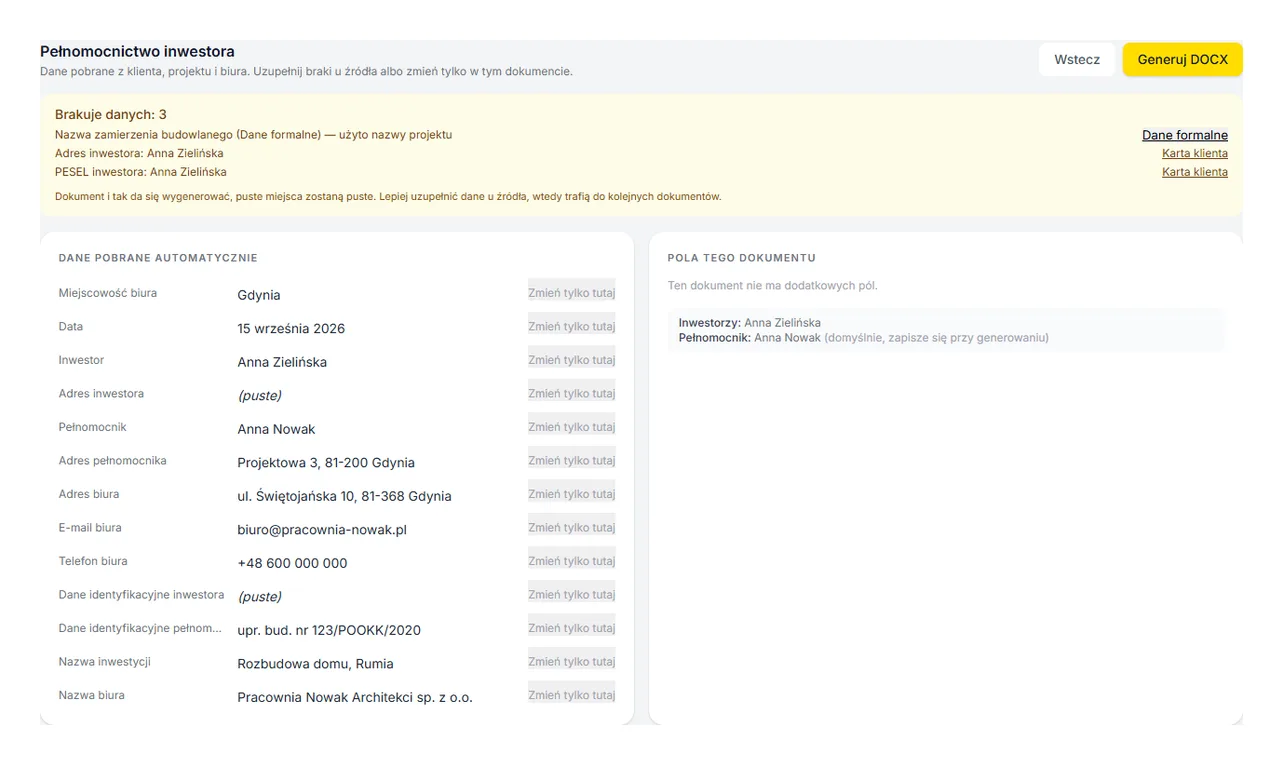
The application form itself (PB-1), the declaration of the right to use the property (PB-5) and the power of attorney are standard official forms; offices working in ArchiFlow generate them from project data, and before generating, the system shows which data is still missing.
Requirements vary between municipalities. Two neighbouring counties can ask for different attachments for an identical house, which is why compiling documents yourself from internet guides is a bad idea. Your architect will simply ask the specific office.
How long it really takes
The authority has 65 days by law to issue a decision, counted from the day a complete application is filed. It faces fines for every day beyond that deadline, so offices do watch the calendar. The catch sits in the word “complete.”
A correction request stops the clock
If the clerk finds a gap, one illegible drawing, one missing approval, they issue a formal request for corrections and the clock stops. After you submit the corrections, the countdown starts over from zero. Three consecutive correction requests can stretch “65 days” into ten months. It happens.
Realistic timelines
Realistic expectations look like this:
| Stage | How long |
|---|---|
| Decision in a smaller county | 4 to 8 weeks |
| Decision in a big city (Warsaw, Kraków) | 2 to 3 months, because they process far more applications |
| Decision becoming final (time for parties to appeal) | roughly 2 more weeks |
Practical tip: ask your architect to file only when every single document is ready. A “let’s see what happens” application with known gaps doesn’t speed things up. It sets you back.
What causes delays
An incomplete application
An incomplete application is the clear number one. Every gap means a correction request, a stopped clock, and several weeks lost.
Objections to the design
Second: the authority’s objections to the design itself. A clerk may find that the building violates the zoning plan or technical regulations, a ridge too high, a wrong roof angle, too much built-up area. Revising the design and getting it rechecked adds weeks.
External approvals
Third: external approvals. A conservation zone, proximity to an airport, access from a national road, each of these pulls another institution into the proceedings, and each has its own timelines.
Neighbours’ appeals
And finally, neighbours. Owners of plots within the project’s zone of impact are parties to the proceedings and can appeal the decision. It’s rare, but with disputed boundaries or a house built close to the property line, an appeal can freeze construction for up to a year.
Notification instead of a permit
A single-family house whose zone of impact fits entirely within your plot can be built on the basis of a notification (zgłoszenie) with a full design attached. The procedure is faster: the authority has 21 days to object, and if it stays silent, you build.
Whether your project qualifies depends on the plot’s geometry, distances to boundaries, and the zoning plan. On a narrow plot where the house stands 4 metres from the fence, the zone of impact often extends beyond the boundary and you’re back to a standard permit. Your architect will assess this honestly, because the notification route doesn’t run equally smoothly in every office.
After the decision: easy things to forget
The permit stays valid for 3 years from the date it became final. If you haven’t started construction by then, it expires and the whole procedure starts again.
Before breaking ground you also need to:
- notify the building supervision authority of your start date,
- appoint a licensed site manager (kierownik budowy),
- open the construction log (dziennik budowy), which since 2023 can be electronic.
These are formalities that take days, but skipping them makes your construction illegal.
Keeping track of your application
Applications filed electronically through the e-Budownictwo portal can be tracked online. For paper applications, it’s a phone call to the architecture department, or, more comfortably, regular updates from your architect.
Agree on a rhythm: a short update every two or three weeks, even if it just says “no change, still waiting.” Offices that run project management systems show the permit as a separate project stage the client can check anytime, without calling. Silence for more than a month is your cue to ask directly whether the case has stalled.
The single best thing you can do as an investor is to build slack into your schedule: assume 3 to 4 months from filing to a final decision, and treat anything faster as a bonus rather than the baseline.
ArchiFlow gives investors real-time visibility into project progress — through one link from the office, with a login if they want one. Ask your architectural office if they use ArchiFlow.
Learn more →