Poland's Architecture Market in 2026 — Numbers, Sentiment, and Lessons for a Small Studio
Around 14,000 licensed IARP architects, noticeably better sentiment in large studios than in small ones, and prices under upward pressure. I went through the available market data to see what it means for a few-person office.


Writing about Poland’s architectural services market with actual numbers is hard, because most studios are micro-businesses that report nothing beyond a tax return. A few sources do exist, and they are worth reading together: the registers of the Chamber of Architects (IARP) and the recurring studio sentiment surveys run by the BCMM research institute. I’ve collected the figures as of 2025/2026 and tried to answer one question: what do they mean if you run a three- or four-person office?
In short
- Around 14,300 licensed IARP architects (September 2025); one- and few-person studios dominate, so you compete with the office around the corner, not a “big player.”
- Sentiment (BCMM, spring 2025): 72% of architects in larger studios rate their office’s situation as good, against 54% in studios of up to three architects.
- Demand: 46% expect last year’s level, 23% growth, 22% a decline; nearly 40% expect service prices to rise.
- For a small office: diversify the commission mix, know what an hour of work really costs, and watch the time from enquiry to signed contract.
How many of us there are
Based on IARP registers, Poland has around 14,300 licensed, practising architects (as of September 2025). The structure has looked the same for years. One-person and few-person studios dominate. Large offices of several dozen people are a narrow elite, concentrated in Warsaw, Kraków, Wrocław and the Tricity.
For a small studio owner, one practical conclusion follows: your competition is exactly as fragmented as you are. In most local markets you don’t lose commissions to a “big player.” You lose them to another three-person studio around the corner. Which means the deciding factors are things you actually control:
- referrals,
- portfolio,
- how fast you answer an enquiry,
- how the client feels while being served.
Sentiment: large studios optimistic, small ones cautious
The spring 2025 edition of the BCMM survey showed a clear split.
| Studios | Rate their office’s market situation as good | Change from the previous edition |
|---|---|---|
| Larger | 72% | +16 percentage points |
| Up to three architects | 54% | no change |
Where does the gap come from? Large offices live off commercial and public investment, which came back after the slump. Small studios depend on individual clients, who react to interest rates, contractor prices, and their own sense of financial safety. That segment recovers slowly and unevenly: a month with three enquiries can sit right next to a month of silence.
Demand and prices: stable, with mild upward pressure
In the same survey, architects’ expectations for demand and service prices over the coming year looked like this:
| Expectation | Demand | Service prices |
|---|---|---|
| Growth | 23% | nearly 40% |
| Previous year’s level | 46% | 45% |
| Decline | 22% | n/a |
Read together, the numbers describe a market that isn’t booming but isn’t collapsing either. Cost pressure does its work regardless: assistants’ salaries, software licences and liability insurance are getting more expensive faster than studio price lists. In this environment you don’t win on volume. You win on the profitability of each commission, which comes down to pricing, scope control, and cutting unpaid iterations.
Three takeaways for a few-person office
Diversify your commission mix
The sentiment split shows the individual-client segment swings hardest. Even a modest stream of work from outside it smooths the revenue curve:
- adaptations of ready-made designs,
- building surveys,
- supervision for institutional investors,
- a standing arrangement with a local developer.
It doesn’t need to be a large share of revenue. It needs to show up regularly.
Raise prices deliberately, not desperately
If nearly 40% of the market expects price increases, a higher price list won’t push you out of the game. Chaos might. A price raise without a structured offer and known per-project profitability is a shot in the dark. Start with the simplest calculation there is: what an hour of your studio’s work really costs, all fixed costs included. Plenty of offices have never done this math and price their projects by looking at the neighbours.
Client experience is the cheapest advantage
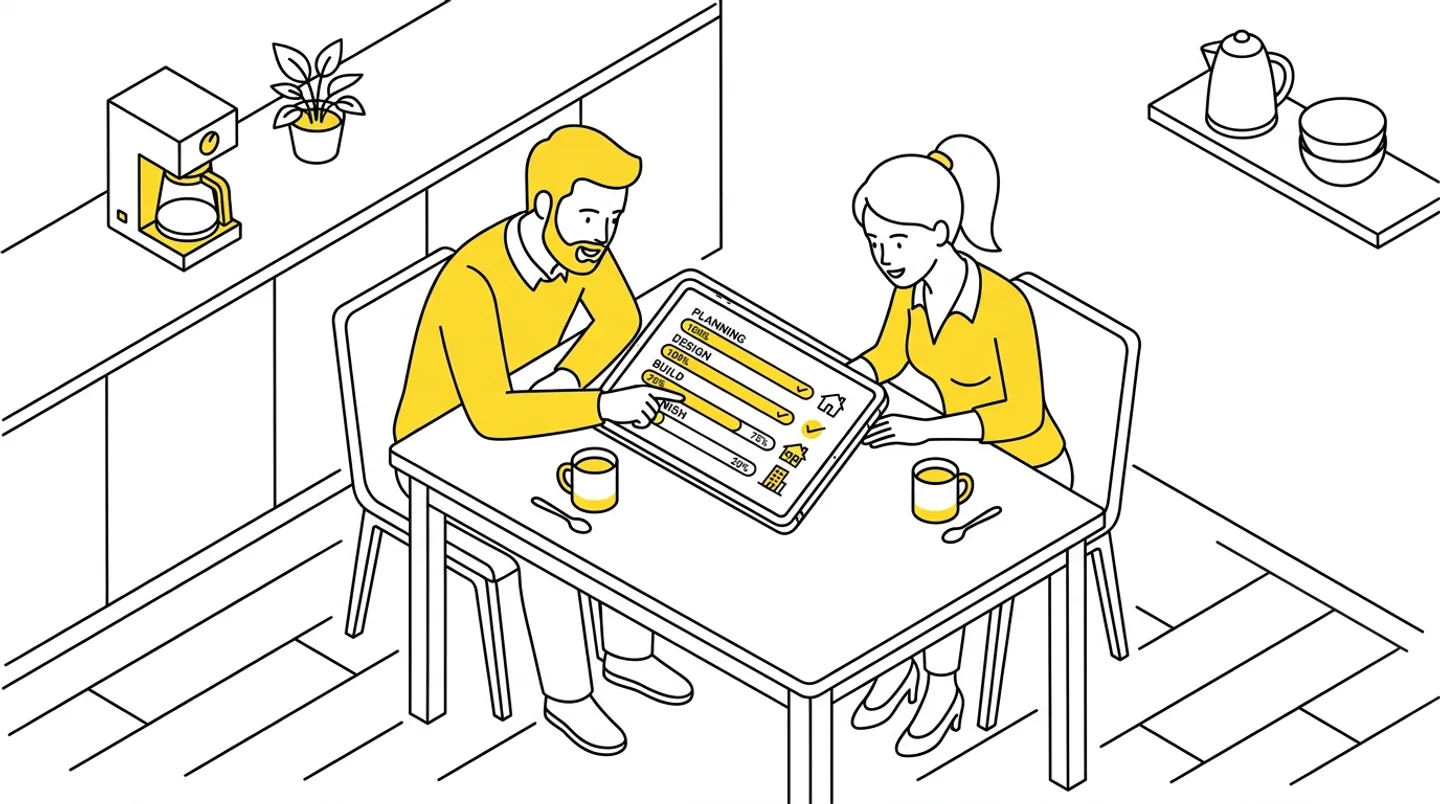
In a fragmented market where the portfolios and rates of neighbouring studios are comparable, the client picks the one that makes them feel in control of the process. Clear stages, visible progress, communication in one place instead of three email threads and two messengers: the ArchiFlow client portal does exactly this. It costs a fraction of a marketing budget, and it’s what the client remembers at the stage that matters most to a small studio: recommending you to friends.
What to watch in 2026
Three signals will tell you more about the individual-client market than any report:
- Interest rates and mortgage availability, because the decision to build a house usually follows the bank’s decision by a few months.
- Contractor prices in your region. When the rate for a building shell rises by double digits year over year, some investors shelve the build along with the design.
- The time from first enquiry to signed contract, the signal closest to home. When it stretches, clients are hesitating, and that is usually the first sign of a cooler half-year, visible long before any survey picks it up.
None of these signals require paid reports. They only require someone in the studio to look at the numbers once a month.
A note on the data
The numbers above come from IARP registers (via the Archistaty service) and BCMM’s 2025 surveys. They are the freshest publicly available data at the time of writing, but Poland’s design services market has no single official report and probably won’t get one soon. Treat these figures as a reference point, not an oracle.
Your own pipeline of enquiries remains the best indicator of the market. It’s worth tracking monthly, even in a plain spreadsheet: how many enquiries came in, from where, and how many turned into contracts.
ArchiFlow gives investors real-time visibility into project progress — through one link from the office, with a login if they want one. Ask your architectural office if they use ArchiFlow.
Learn more →